Pigeon is the brainchild of many, many discussions between Colton and Kendahl. We both studied GIST at Texas A&M together, and consider each other to be the others best friends. We both have had fairly successful early careers in the GIS world, but we see Pigeon as an opportunity and an outlet to grow, learn, and mainly share our belief that there aren’t many problems GIS can’t solve.
In 1907, German apothecary Julius Neubronner used pigeons to deliver medications to patients. A time-delayed mini camera was attached to the pigeon during the patent process, and boom- one of the first kinds of remote sensing was created, and later used in WW2. It’s unclear how extensive aerial photography via bird was for war reconnaissance, but the idea stands, and can sum up our take on GIS and remote sensing as a whole. Small, creative ideas can lead to large scale, life-changing products.
All too commonly in tech and software, certain ideas and techniques aren’t utilized for long before being replaced by something “better”. Machine learning is used when simple classification methods would be just (if not more) as accurate. Artificial intelligence detects edges and topology when open-source scripts are proven to do the job. Tools, workflows, and approaches that once seemed revolutionary can rapidly fall out of favor as new technologies emerge. While innovation drives progress, constant abandonment also leads to inefficiency, lost knowledge, and unnecessarily complex systems.
Here is where Pigeon comes in- a think tank, dedicated to recognizing GIS should evolve, be streamlined, and used in ways that are adaptable and long lasting, rather than fleeting.
At the end of the day, the tools aren’t the problem, its how and why we use them. Drones, AI, clouds, the humble shapefile… all of these have a place when matched with the right setting and the right research question. This blog is part of our vision to spark this critical reflection, challenge how we think about geospatial tools, and encourage smarter, more intentional use. The challenge, and opportunity, is to be intentional. Recognize when simplicity outperforms complexity, and when cutting-edge technology can’t (or can!) genuinely transform outcomes.
Let’s ensure the work we do and share today doesn’t just make noise, but makes change.
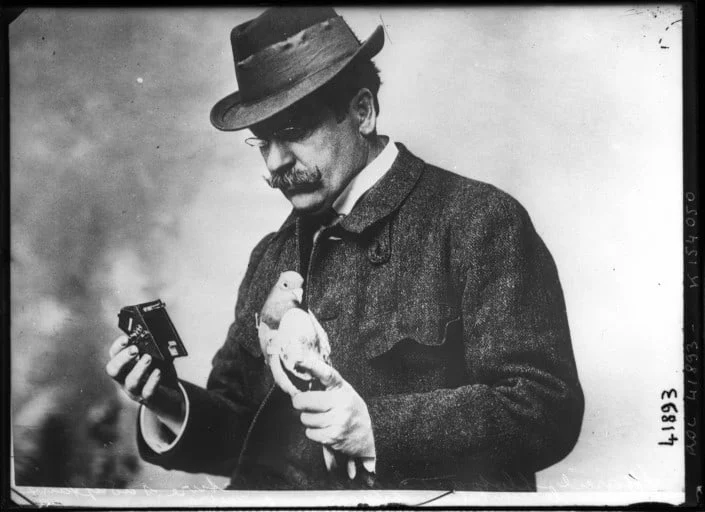
1914, Julius Neubronner and his pigeon. Source: https://www.geographyrealm.com/before-there-were-drones-using-pigeons-for-aerial-photography/

 Pigeon.
Leave a reply to Andrew Tanner, PhD Cancel reply